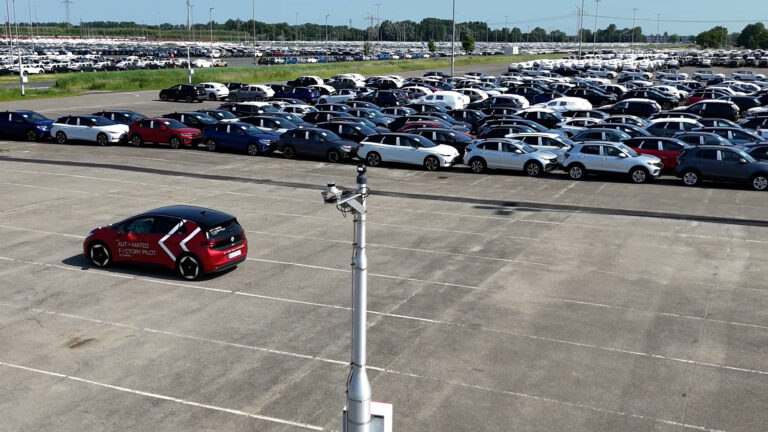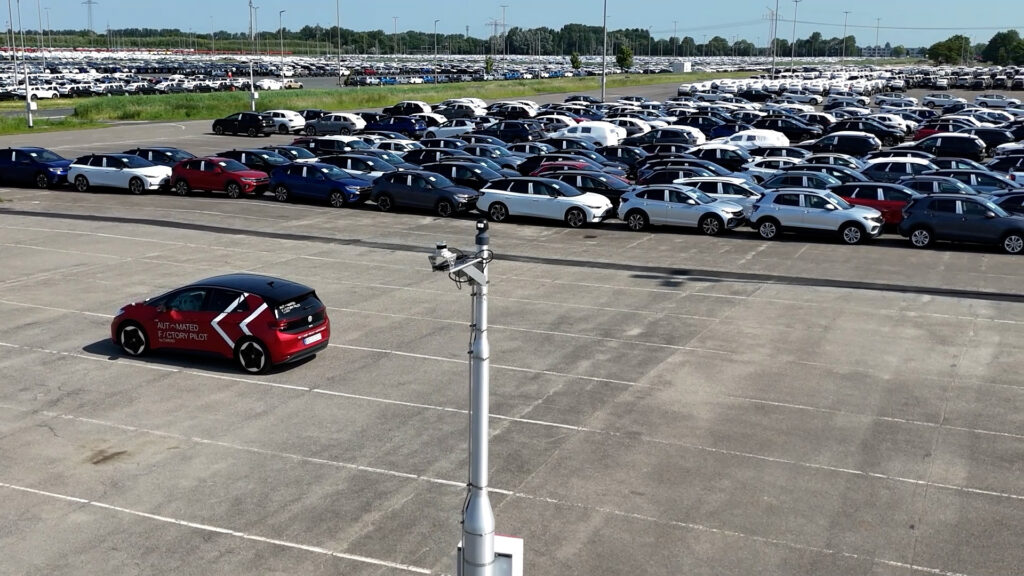
Each day, millions of vehicles are driven around in gated areas, outside the public roads. Brand new passenger cars on their way from factories to dealers, buses in depots, trucks and trailers in logistics centers and delivery vans in last-mile delivery centers. This traffic runs 24/7, all year long.
Nearly all of these vehicles are being moved from A to B by human drivers. And that is becoming a massive challenge for the industry.
All these logistics applications are today facing massive problems with driver capacity, flexibility and cost – and most critically with performance. Skilled drivers are not available or have limited working hours. Volatility and demand are increasing in parallel. And finally, there is a constant demand to accelerate digitalization and automation to keep up with the market.
Today, this is no longer sustainable. To build the future, we must let go of the past.
The End of Manual, Rule-Based Logistics for Gated Areas
For decades, logistics strategies, systems and processes were shaped around human limitations, manual decision-making and rigid rulebooks. As the challenges and problems in the logistics industry increase dramatically, the traditional methods and tools are at their end.
Instead, new solutions and technologies are in high demand. The future is built with automated and autonomous driving, combined with automated and autonomous decision-making. Together, this is a powerful combination that overcomes the challenges with the legacy methods that rely on manual work and human effort.
The technologies are already here. The gateway to the future of logistics in gated areas is already open.
Unikie Marshalling – Re-Inventing Gated Areas Logistics
Unikie has developed an automated marshalling solution that automates all driving within gated areas. Unikie Marshalling Solution is available for a wide range of industries such as automotive production, automotive logistics, truck logistics, port logistics, bus depots and special areas such as mining.
Traditional logistics areas operate with approximately 50 human drivers at the same time and have to optimize their operations within these constraints. Unikie’s technology eliminates this limitation: with automated driving, all vehicles can be moved simultaneously – without drivers, without waiting times, without human restrictions.
Combining the Unikie Marshalling Solution with AI‑based logistics opens entirely new operational dimensions. With the introduction of AI‑based decision-making systems combined with fully automated and autonomous driving systems, the degree of freedom for logistics strategies reaches a new height.
Where limitations once dominated, a world of nearly unlimited operational flexibility is now opening.
AI Agents – New Intelligence of Logistics
The real revolution in gated area logistics does not come from autonomous driving alone, but from the combination of automation and autonomous decision-making. This requires a new form of software intelligence: AI agents.
What AI agents are ideal for:
- Defining goals independently
- Negotiating between different systems
- Making decisions autonomously
This architecture creates an ecosystem in which vehicles, charging stations, workshops, parking areas, washing stations, and infrastructure work together like an intelligent team.
So, what AI agents can do in practice?
AI agents can optimize operations in a gated area dynamically, without static and pre-defined rules. When circumstances change due to some rare or unforeseen element, the operations do not halt as the AI agents can autonomously maneuver around the obstacle.
AI agents can negotiate autonomously between vehicles and the surrounding infrastructure. For example, when a vehicle enters the gated area, agents can optimize the service sequence based on the vehicle’s needs and availability at the facility.
Also, as AI agents are able to utilize collective intelligence instead of centralized control, they eliminate human bottlenecks that slow down decision-making.
As a real-life example, consider a bus arriving at a bus depot. When entering the depot, the bus automatically communicates its status to the depot: departure time, charging needs, cleaning requirements and repair needs, for instance. The bus then negotiates simultaneously with AI agents responsible for charging, workshop, cleaning, washing station and parking area. Within seconds, an optimal sequence is created.
15,000 hours saved
Efficiency gains 15,000 hours saved per year for a 100-bus depot.
€650,000 of costs saved
Cost savings €650,000 saved annually per depot, over €1 billion across Europe.
Enhanced productivity
Enhanced productivity as drivers focus on passenger services.
Source: Swiss Association for Autonomous Mobility (SAAM)
Future Outlook – How Unikie Revolutionizes the Industry
Unikie collaborates with leading vehicle OEMs, for buses, trucks, LCVs, cars and special purpose vehicles to provide fully integrated automation solutions for gated areas. We build best-in-class turnkey solutions, which are customized for each individual case by integrating the Automated Marshalling Solution to proprietary and leading ecosystem partner solutions. In addition, we provide AI agent decision-making on top of our solution, allowing the implementation of instant, fully automated driving.
I clearly see the industry beginning to transform, with the future pointing towards fully automated depots as automated vehicles and instant decision-making systems become more prevalent.
We are shaping the future of logistics – and we invite you to be part of it.
Author

Joachim Hauser
Joachim Hauser was an executive at BMW AG before he joined Unikie. With experience in auto-industry and especially in automated driving, together with Unikie management he formed the way for entering the market. Today Joachim Hauser is in charge of strategy and sales of Unikie Marshalling.