“One year of 100% AI-driven development — what I learned, and what it means for your organisation.”
About a year ago, I made a decision that changed how I work. I had been experimenting with AI-assisted development for a while, and the tools had finally reached a point where I trusted them with real production work. So I went all in. Every feature, every bug fix, every refactoring task.
I never went back. Not once.
I didn’t plan for it to be permanent. It just never made sense to go back. I have been writing code for over 40 years. I am not someone who chases trends. But after a full year of AI-driven development, I can say with confidence: this is simply how software gets built now. The efficiency gains are real — tasks that used to take weeks now take days. But the efficiency wasn’t the most important thing I learned.
The most important thing was where the bottlenecks moved.
The shift nobody warns you about
Most conversations about AI in software development focus on speed. “Developers will be 2x faster.” And yes, that’s true. But speed is the easy part to understand. The hard part is what happens next.
When I started working with AI, I made a mistake early on. I rushed straight into generating code before I had properly thought through the architecture. AI happily produced exactly what I asked for — fast, confident, and wrong. Not because AI was bad, but because my instructions were bad. I had gaps in my thinking, and AI filled them. Confidently. Incorrectly.
That experience taught me the real lesson: AI doesn’t remove thinking from development. It removes the safety net that hid unclear thinking.
In traditional development, the slow pace of writing code gives you time to discover what you actually need along the way. You think while you type. You figure things out as you build. The process itself hides your confusion. We even celebrated this. We called it agile.
With AI, that hiding place is gone. If your thinking has gaps, you get broken code back in minutes. There’s nowhere to hide.
What actually changed
The work didn’t disappear. It shifted. From execution to decision-making. From typing to thinking.
Before AI, a developer’s skill was hidden inside the implementation. You demonstrated competence by writing good code. Now, that skill is exposed and amplified. You demonstrate competence by making good decisions — about architecture, constraints, interfaces, and trade-offs. Then AI handles the implementation.
Think of AI as a brilliant junior developer. Incredibly fast, technically skilled, never tired — but with no understanding of the big picture. It doesn’t know your system. It doesn’t know your constraints. It will confidently write code that doesn’t scale or violates your architecture.
Someone needs to catch that. Someone needs to provide clear intent, explicit constraints, and critical review. That someone is your senior engineer — and their job just became more important, not less.
The bottleneck migrates
Here’s what surprised me the most, and this is the part that matters for anyone thinking about teams and organisations, not just individual productivity.
When my bottleneck moved from implementation to thinking, it didn’t stay with me. It moved upstream. And downstream.
If developers are now 2 or 5 times faster at implementation, what happens to the project?
In my current project, we’re living this right now. Product owners can’t decide fast enough what we should build next. Testing can’t verify fast enough what we’ve already built. We developers are waiting for tickets. Meanwhile, the “Ready for Testing” column is overflowing.
The first instinct was to hire another tester. That helps — but it treats the symptom, not the cause.
AI-driven development doesn’t just change how developers work. It changes where the bottlenecks live. And if the organisation doesn’t adapt, you just move the traffic jam. You don’t solve it.
This is the conversation that leadership teams need to have. Not “how do we make developers faster” but “how do we restructure our workflow so the entire pipeline can absorb that speed?”
What stays the same
But before anyone gets the wrong idea, developers are still responsible for correctness, quality, and outcomes. They still own design decisions and technical trade-offs. They are still accountable for what goes into production.
Bugs still happen. Build issues still exist. Systems remain complex and sometimes unpredictable. AI doesn’t make any of this disappear. It helps you deal with it faster.
Code still needs critical review. Tests are still necessary. Experience still matters — more than ever.
AI changes how you work, not what you’re responsible for.
The new core skill
After a year of doing this full-time, I have found that AI-driven development comes down to one core skill: clarity. The ability to be explicit about what you want, why you want it, and if the result is actually right. Clarity breaks down into three disciplines:
Thinking. Being explicit about what you want before you ask AI to build it. Clarifying requirements, intent, and constraints upfront. This is the hardest skill to develop, because most of us have spent decades thinking while coding, not before coding.
Deciding. Making design choices, trade-offs, and architectural calls that AI cannot make for you. AI doesn’t know your business context, your users, or your technical debt. These decisions are yours.
Reviewing. Critically evaluating what AI produces. Not just clicking approve — actually reviewing. Understanding the code, questioning the approach, catching the assumptions AI made that you didn’t state.

These three skills are what separate a developer who uses AI from a developer who is effective with AI. And for organisations, these are the skills worth investing in.
What this means for your organisation
If you lead a technology team, here is what I would want you to take away from my experience:
AI-driven development works. Not as an experiment or a productivity hack, but as a fundamental way of building software. I have done it for a full year across real production work and never hit a wall where I had to say “AI can’t do this.”
But adopting AI isn’t just a developer tooling decision. It’s bigger than that, and in two ways.
First, it’s an organisational change. When implementation speeds up dramatically, the bottlenecks move to decisions, requirements, and verification. If you only optimise the developer layer, you are building a faster locomotive on the same old track. It hardly goes any faster.
You have to upgrade the track too.

Second, and this is the part people underestimate: you can’t just hand a developer an AI agent and say “use this.” That is like giving dynamite to a miner who has spent twenty years with a pickaxe.
You might get results faster — or you might get a collapsed mine. In software, the collapsed mine is a codebase where AI has been let loose without judgment. Architecture eroded, technical debt multiplied, subtle bugs baked into production. I know, because I almost did it myself in my first AI-driven project.

The developers who succeed with AI are the ones who already think clearly about systems, constraints, and trade-offs — and who have built the discipline to guide AI rather than follow it. AI amplifies that skill. It also ruthlessly exposes when it’s missing.
This is why experienced engineers are more valuable now, not less. Their system knowledge, their domain expertise, their judgment — AI doesn’t have any of that. But combined with AI, an engineer who has that clarity can deliver at a pace that wasn’t possible before. The gap between a developer who uses AI and a developer who is effective with AI is enormous. And that gap has a name. It’s clarity. It determines whether AI becomes your competitive advantage or your most expensive source of technical debt.
The answer is to train the miner before you hand over the dynamite. A certified blaster wasn’t just someone who was given explosives. They were trained, tested, and trusted with them. That’s what your developers need: not just access to AI, but the skills and judgment to use it effectively. A skilled miner doesn’t need to throw away the pickaxe — they know when each tool is right for the job.
“AI didn’t make me less of a developer. It forced me to become the one I thought I already was.”
Author:
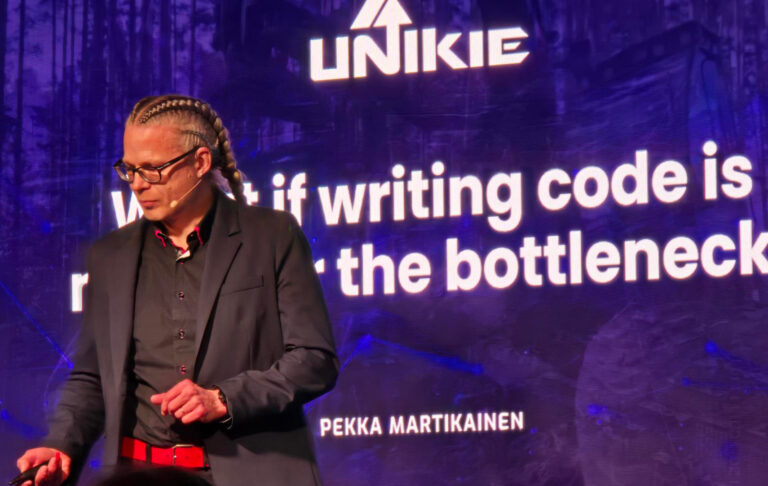
Pekka Martikainen
Pekka Martikainen brings 25 years of software engineering experience to bridging engineering and strategy at Unikie — building AI-driven software while helping the organisation adapt to a new way of working.