AI-driven development requires a new approach to building software. Unikie has made its own AI leap and is now working alongside its customers to turn the benefits of AI into practical results.
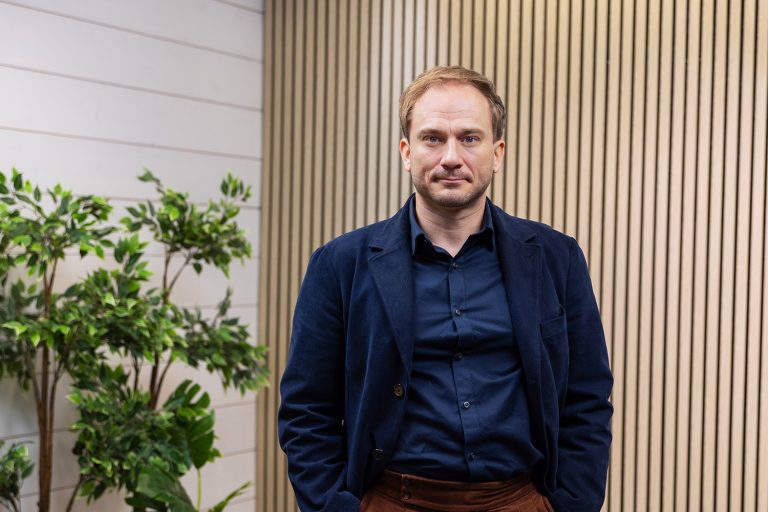
“Technology is evolving faster than ever,” says Unikie’s Chief Delivery Officer (CDO), Juha Kemppainen.
As code production accelerates, the software industry and companies’ business models are undergoing a historic transformation.
Artificial intelligence is rapidly moving into the physical world – machines, vehicles, and devices – where complex functions are performed locally and solutions must be lightning-fast while remaining safety-critical. Developing physical AI and embedded systems requires a fundamentally different approach.
In response to this rapid pace of change, Unikie has developed UnikieMind – an AI-based model and methodology that brings AI-native software development into customers’ product development organizations. It is not just a new tool, but a comprehensive way to rethink how software is designed, built, and maintained.
From internal transformation to customer advantage
Unikie is not bringing this new operating model to customers without first proving it internally. The company has already made its own AI leap in software development. AI Catalyst Pekka Martikainen, who works at Unikie, and numerous other experts have already switched to 100% AI-assisted software development. Through internal training and the insights of hundreds of experts, Unikie has achieved a significant productivity boost in its own research and development projects.
Now Unikie is bringing the same approach to its customers.
With the help of UnikieMind, Unikie’s AI-native engineers work alongside customer teams to turn the benefits of AI into practical outcomes. As code creation accelerates, the customer organization’s own AI capabilities are also elevated to a new level.
What is UnikieMind, and who is it for?
UnikieMind is designed for engineering and product development teams ready to take the next step in using artificial intelligence. It supports the full software development lifecycle, including needs assessment, design, coding, testing, documentation, and maintenance.
Juha Kemppainen emphasizes that UnikieMind is far more than a technical platform – it is a methodology. It combines Unikie’s deep expertise from a decade of demanding customer projects with the latest commercial language models.
“It is important to understand which tasks UnikieMind and the agentic platform are best suited for,” Kemppainen points out.
The term agentic platform is still new and evolving. According to Kemppainen, it may mean something different in six months than it does today. Put simply, an agent is an AI-based software component that can independently carry out assigned tasks or goals. When several agents are coordinated through orchestration, we can speak of an agentic platform.
However, because technology evolves so quickly, customers are not simply buying agents from Unikie.
“An agent built today may be obsolete in six months because something newer and more efficient has replaced it. Customers choose Unikie because of our long experience in applying artificial intelligence and our deep understanding of their industry domain. We can build agents quickly, but the real value comes from that underlying domain expertise,” Kemppainen says.
Focus on quality and process harmonization, not just speed
The AI debate is dominated by talk of speed. However, Kemppainen stresses that in the midst of today’s intense AI boom, the focus must remain on quality – not speed alone.
As AI accelerates the coding phase of software development, it also exposes the real bottlenecks in companies’ processes. The slowdown is usually found elsewhere: often in human-driven areas such as decision-making, requirements definition, or architecture design, which cannot yet keep pace with artificial intelligence.
This is where UnikieMind delivers its greatest value.
The methodology is used to identify and remove these bottlenecks. According to Kemppainen, the goal is not to force every human function to match the speed of artificial intelligence, but to harmonize the entire software development process. When the whole system is balanced, bottlenecks disappear and the speed gains delivered by AI translate into real quality and business value.
UnikieMind Catalyst turns change into action
Turning a concept into a real-world solution does not happen overnight. That is why Unikie has launched the UnikieMind Catalyst package – an 8–12 week engagement during which Unikie’s AI engineers work closely alongside the customer’s team.
“During this period, the customer’s most valuable AI use cases are identified, rapid concept implementations are defined, and a roadmap for the future is created,” says Juha Kemppainen. “It is not just about outsourced coding, but about helping the customer’s own organization adapt to the new era of artificial intelligence.”
AI is changing the rules of the game, and the companies that learn to combine the speed of artificial intelligence with deep industry expertise and harmonized processes will be the winners of the future. UnikieMind offers a proven roadmap and experienced guides for that journey.
This article was originally published in Finnish in Tekniikka & Talous.
In the picture (from left to right): Conor Lennon, Elina Mansner, Juha Kemppainen and Julia Karjalainen